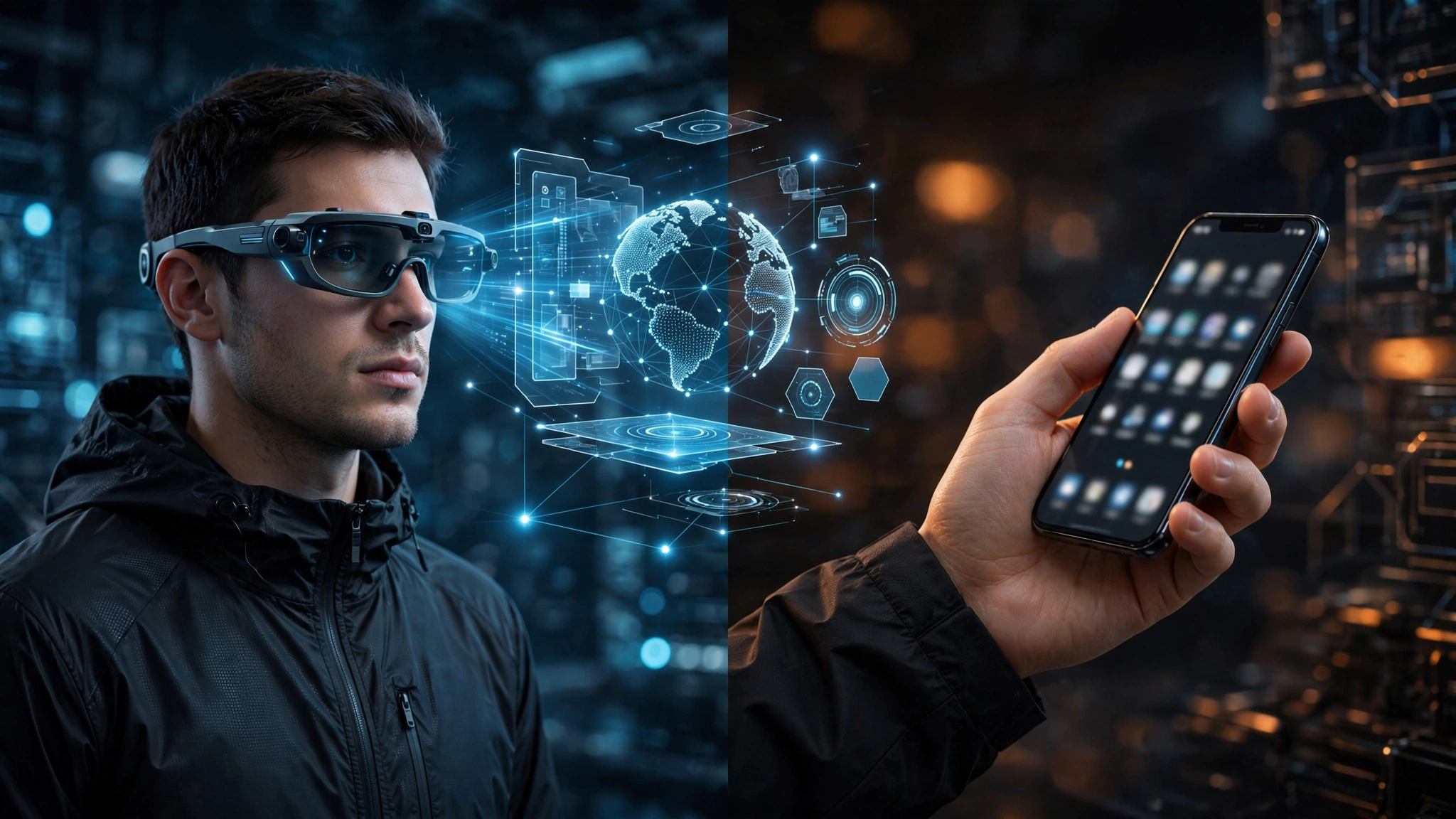
For more than fifteen years, the smartphone has been the undisputed center of our digital lives. From checking emails and managing finances to capturing memories and navigating foreign cities, mobile devices have transformed into essential extensions of ourselves. However, a major technological shift is underway. As mobile displays reach their physical limits, major tech giants are pouring billions into next-generation wearables.
This raises a pivotal question: Will smart glasses replace smartphones, or will they simply exist alongside them?
While lightweight frames, spatial computing, and heads-up displays promise a future free from staring down at rectangular screens, key hardware and societal hurdles remain. Exploring the core technology, practical advantages, current limitations, and market trajectory reveals whether smart glasses will become our primary window to the digital world.
The Shift Toward Wearable Computing
The way we interact with information is evolving from hand-held interfaces to hands-free visual overlays. Mobile phones forced humanity to look down; smart glasses aim to bring our eyes back up to the world.
The Rise of Heads-Up Interfaces
Smartphones require users to break context constantly. To look at a map, read a message, or check a schedule, you must physically pull out a device and look down at a glass screen. Smart glasses reverse this dynamic by using micro-displays or light engines to project text, navigation vectors, and visual data directly into your line of sight. This shift to a heads-up interface allows users to absorb digital information without disengaging from their physical surroundings.
Spatial Computing and Contextual AI
The primary driver behind the smart glasses movement is the integration of multimodal Artificial Intelligence and augmented reality (AR). Unlike a smartphone that only responds when tapped, AI-driven smart glasses can “see” what you see and “hear” what you hear. They offer context-aware assistance in real time:
- Instant Translation: Overlaying translated text directly over physical foreign-language signs or providing live audio captions during conversations.
- Proactive Context: Displaying step-by-step instructions or object recognition without requiring a manual search query.
- Hands-Free Productivity: Allowing field technicians, chefs, or athletes to read manuals or metrics while keeping their hands free.
Smart Glasses vs. Smartphones: Key Comparison
To understand if smart glasses can usurp the smartphone, we must compare how both form factors handle essential daily tasks.
| Feature / Metric | Smartphone | Smart Glasses |
| Primary Interaction | Touch screen, typing, gestures | Voice commands, subtle touch, spatial gestures |
| Display Area | 6 to 7-inch fixed physical screen | Infinite virtual field-of-view via AR overlays |
| Context Awareness | Manual input (app launching) | Passive ambient AI (sees/hears environment) |
| Battery Life | 12–24 hours of heavy usage | 2–6 hours (varies by display intensity) |
| Media Consumption | Ideal for high-res video & typing | Ideal for short glances, audio & navigation |
| Ergonomics | Fits in pocket; requires holding | Worn on face; requires minimal physical effort |
Why Smart Glasses Could Win
The consumer appetite for less screen time and more friction-free tech is creating room for wearable eyewear to win over key everyday use cases.
                 SMARTWARE CONVERGENCE
┌────────────────┐     ┌────────────────┐     ┌────────────────┐
│  Smartphones   │ ──► │ Ambient Companion │ ──► │  Primary Hub   │
│ (Screen-First) │     │ (Voice & AR)   │     │ (Smart Glasses)│
└────────────────┘     └────────────────┘     └────────────────┘
Unmatched Hands-Free Convenience
The clearest win for smart glasses is mobility. Whether navigating turn-by-turn through busy city streets, capturing spontaneous photos without pulling out a camera, or reading a recipe while cooking, eliminating the physical handset creates a vastly superior user experience.
Reduction in Screen Addiction
Smartphones are designed around immersive engagement, often trapping users in endless scrolling loops. Smart glasses favor “glanceable information”—quick bursts of visual data (notifications, directions, alerts) that appear for a few seconds and dissolve. Early adopters report a significant drop in passive smartphone screen time when wearing smart eyewear.
The Bottlenecks Holding Smart Glasses Back
Despite their immense potential, smart glasses face steep engineering, psychological, and social barriers before they can fully replace mobile phones.
Thermal and Battery Physics
Packing a high-performance processor, cellular modems, micro-projectors, and cameras into a frame weighing under 50 grams is an immense engineering challenge. Lithium-ion battery technology has not scaled down fast enough to power dense spatial graphics all day without causing thermal throttling or overheating near the user’s temples.
Complex Input and Typing Limitations
Smartphones excel because multi-touch keyboards allow rapid text entry, precise photo editing, and seamless app navigation. Voice commands on smart glasses work well in private, but speaking out loud to dictate messages or access private bank accounts on public transit is socially awkward and insecure. Until neural wristbands, ring controllers, or subtle micro-gesture tracking mature, high-speed input remains a phone advantage.
Social Acceptance and Privacy Concerns
Cameras mounted at eye level raise immediate public privacy issues. Bystanders are often uncomfortable not knowing if they are being recorded or analyzed in real time. Until subtle recording indicators, clear industry standards, and strict on-device data scrubbers are universally adopted, public pushback will persist.
The Horizon: Companion First, Replacement Later
Will smart glasses replace mobile phones entirely? The short answer is not immediately, but incrementally.
Phase 1: The Powerful Companion (Present – 2028)
Smart glasses are currently serving as “peripheral expanders” for smartphones—much like smartwatches did a decade ago. The smartphone acts as the heavy compute engine in your pocket, offloading lightweight visual notifications, audio, and AI processing to the frames over high-speed wireless networks.
Phase 2: The Primary Computing Hub (2029 and Beyond)
As microLED displays become brighter, silicon becomes more efficient, and wrist-based gesture control matures, smart glasses will handle 80% to 90% of everyday computing tasks. The traditional smartphone will likely fade into a slab-shaped pocket server—or disappear entirely into cloud-linked ambient networks.
Smart glasses may not make smartphones obsolete tomorrow, but they are steadily inheriting the moments that make mobile phones useful. The future of personal computing isn’t held in your hand; it rests right in front of your eyes.