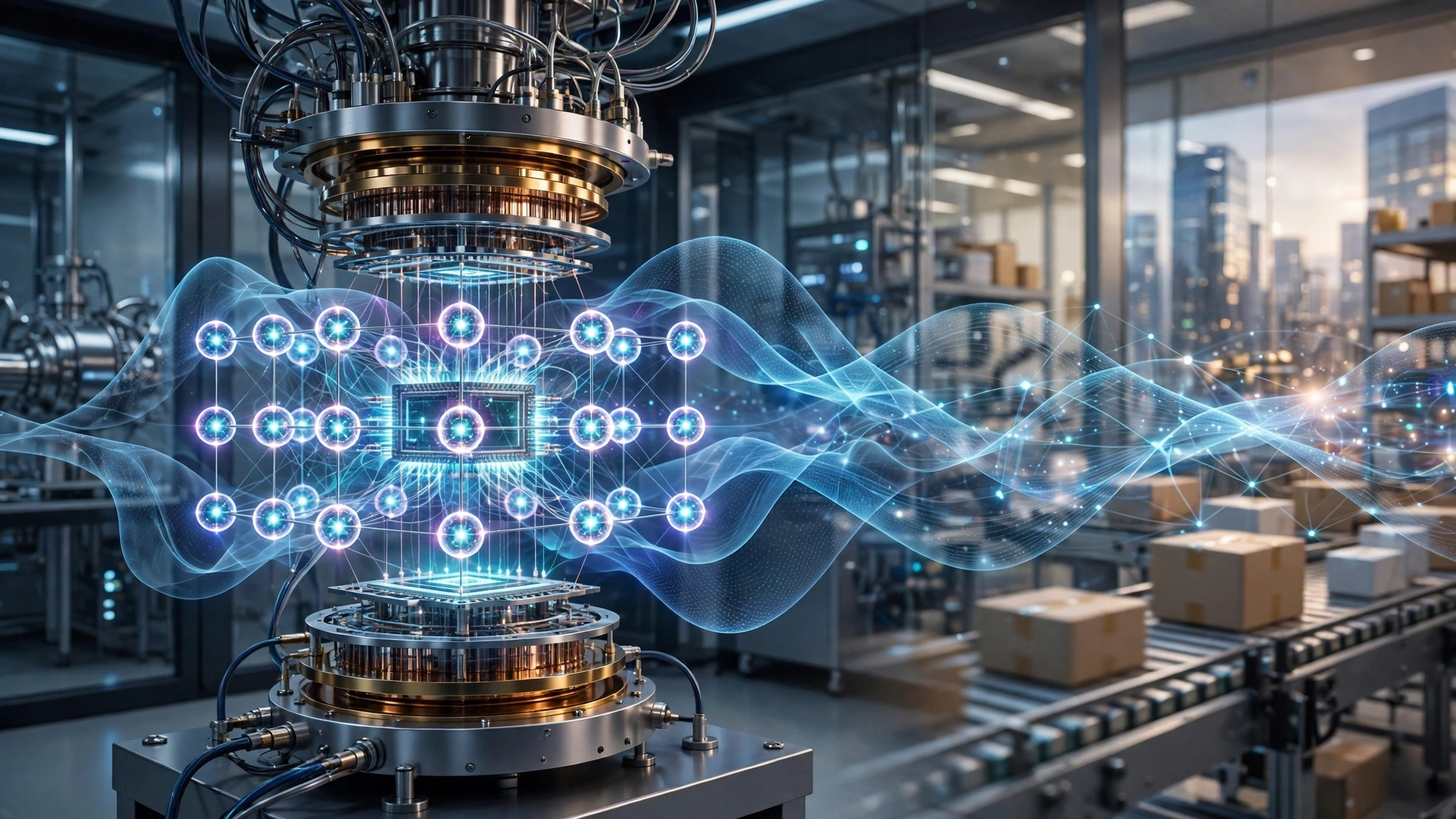
The boundaries of modern physics and computer science are colliding in a high-stakes race toward a single target: achieving practical, scalable commercial value from quantum systems. For over two decades, quantum computing was largely viewed as an exotic, lab-bound experiment—fascinating in theory, yet far too unstable to compete with classical supercomputers.
That narrative has shifted dramatically. Today, quantum computing is transitioning from pure physics research to an engineering discipline. With breakthroughs in fault tolerance, exponential error correction, and hybrid cloud architectures, enterprises are no longer asking if quantum computers will deliver practical value—they are actively planning for when.
The question remains: How close are we to commercial breakthroughs, and what stands between present capabilities and widespread adoption?
The Reality Check: Where Quantum Computing Stands Today
To evaluate commercial readiness, it is vital to distinguish between hype and tangible engineering progress. Quantum computing has historically operated within the NISQ (Noisy Intermediate-Scale Quantum) era. NISQ systems contain anywhere from 50 to a few hundred physical qubits. However, because qubits are extraordinarily sensitive to environmental interference—such as heat, electromagnetic radiation, and atomic vibrations—they suffer from high error rates and rapid decoherence.
The current phase is characterized by an evolution toward early fault-tolerant quantum computing. Rather than simply adding more physical qubits to a chip, the industry focus has pivoted toward creating high-quality logical qubits—virtual qubits formed by combining hundreds or thousands of physical qubits wrapped in quantum error correction (QEC) protocols.
Key Benchmarks Achieved So Far
- Hardware-Scale Error Correction: Major breakthroughs have proved that as surface-code lattices expand, error rates drop exponentially rather than compound. This offers concrete evidence that fault-tolerant scaling operates as predicted by theorists.
- Alternative Modalities Gaining Traction: While superconducting circuits remain a major pillar, neutral-atom platforms (using lasers to manipulate thousands of isolated atoms) and trapped-ion systems are demonstrating longer coherence times and vastly denser connectivity.
- Hybrid Workflows: Hardware providers and cloud hyperscalers have integrated Quantum Processing Units (QPUs) alongside traditional High-Performance Computing (HPC) environments. Commercial users do not run entire pipelines on quantum chips; instead, specific mathematical bottlenecks are offloaded to QPUs within classical pipelines.
Industries on the Verge of Quantum-Driven Disruption
While universal quantum supremacy across all compute tasks remains down the road, domain-specific commercial value is emerging much faster. Commercial adoption is advancing rapidly in several key target areas:
Molecular Simulation and Materials Science
Classical computers struggle to accurately simulate atomic interactions because every added electron exponentially increases computational complexity. Quantum systems natively operate using quantum mechanics, allowing them to map molecular states naturally.
- Pharmaceutical Development: Simulating complex target proteins and drug candidate interactions at the molecular level drastically reduces wet-lab trial iterations, accelerating early-stage drug discovery from years to months.
- Energy & Materials: Designing denser battery chemistries for electric vehicles, creating room-temperature superconductors, and discovering lightweight alloys for aerospace applications.
Dynamic Logistics and Complex Optimization
Global supply chains, air traffic routes, and telecommunication networks involve thousands of interdependent variables. Classical algorithms rely on approximations when dealing with massive combinatorial spaces.
- Supply Chain Routing: Quantum annealing and hybrid algorithms process multi-variable logistical constraints simultaneously to minimize fuel cost, vessel downtime, and global shipping delays.
- Manufacturing Efficiency: Optimizing factory robotics sequences and scheduling pipelines in real time to reduce energy consumption and output bottlenecks.
Financial Modeling and Risk Analysis
Financial markets are non-linear, unpredictable, and driven by vast datasets.
- Portfolio Optimization: Quantum systems evaluate thousands of asset risk profiles simultaneously under extreme market conditions, delivering sharper risk management.
- Fraud Detection and Pricing: Analyzing subtle, high-dimensional patterns in transaction streams to detect anomalous fraud markers in real time.
The Core Technical Barriers Remaining
Despite undeniable progress, several engineering hurdles must be cleared before quantum computing becomes an everyday corporate asset.
           [ Physical Qubits ] ── (High Error / Decoherence)
                                       │
                                       ▼
                      [ Quantum Error Correction (QEC) ]
                                       │
                                       ▼
                   [ Logical Qubits (Fault-Tolerant) ]
                                       │
                                       ▼
           [ Scale: 1,000+ Logical Qubits for Commercial Advantage ]
1. The Scaling Ratio (Physical vs. Logical Qubits)
A useful commercial quantum computer capable of cracking complex industrial problems will likely require 1,000 to 10,000 stable logical qubits. Under current error-correction schemes, producing just one logical qubit can demand anywhere from hundreds to thousands of physical qubits. Scaling up to millions of physical qubits requires massive leaps in chip fabrication, interconnects, and control electronics.
2. Cryogenic and Control System Bottlenecks
Superconducting quantum chips require dilution refrigerators to operate at temperatures colder than deep space (near absolute zero). Cabling thousands of microwave control lines into a sub-kelvin cryogenic chamber creates significant thermal and spatial limitations. Transitioning to integrated photonic links or room-temperature optical tweezer systems (such as neutral atom setups) is vital to bypass this thermal wall.
3. Software and Algorithmic Maturity
Hardware is only half the equation. Developing quantum algorithms that deliver a true “quantum speedup” over highly optimized classical algorithms (like tensor networks) requires an entirely different software paradigm. Writing, debugging, and compiling quantum code remains a specialized skill set with a severe talent shortage worldwide.
Timeline to Impact: The Roadmap Ahead
Commercial value will arrive in distinct waves rather than a single overnight event.
| Phase | Timeframe | Hardware Capability | Primary Enterprise Use Cases |
| Hybrid Pilot Era | Present – 2027 | 10–50 Logical Qubits (NISQ + Early QEC) | Industry R&D experiments, cloud-based hybrid proof-of-concepts, simple drug simulations. |
| Application-Specific Advantage | 2028 – 2031 | 100–500 Logical Qubits | Production-level battery chemistry design, targeted financial modeling, specialized logistics optimization. |
| Universal Fault Tolerance | 2032+ | 1,000+ Fault-Tolerant Logical Qubits | Full molecular synthesis, universal optimization, cryptographic migration (Post-Quantum Cryptography). |
How Enterprises Should Prepare for the Quantum Transition
Waiting for fully fault-tolerant hardware before taking action risks falling behind competitors who built early internal capabilities. Forward-thinking organizations are taking three actionable steps today:
- Audit High-Value Compute Bottlenecks: Identify internal computational tasks—such as complex simulations, financial optimization models, or machine learning pipelines—that scaling classical infrastructure cannot resolve efficiently.
- Adopt Quantum-as-a-Service (QaaS): Major cloud ecosystems offer direct pay-as-you-go access to real quantum hardware. Enterprise developers can build and benchmark algorithms on existing cloud processing units without requiring hardware capital expenditure.
- Upgrade to Post-Quantum Cryptography (PQC): The long-term threat of quantum hardware breaking standard RSA/ECC encryption demands immediate action. Organizations must map sensitive legacy data and begin migrating toward NIST-standardized quantum-resistant algorithms to secure their infrastructure.
The Commercial Horizon
We are no longer in the phase of questioning whether quantum computing is physically possible. The transition from physics to engineering is under way. While widespread, universal quantum computing remains a target for the next decade, early commercial advantage in fields like chemistry, materials science, and specialized optimization is arriving much faster via cloud-integrated hybrid models. Organizations that build quantum literacy and hybrid infrastructure today will be the ones positioned to lead when the breakthrough tipping point arrives.