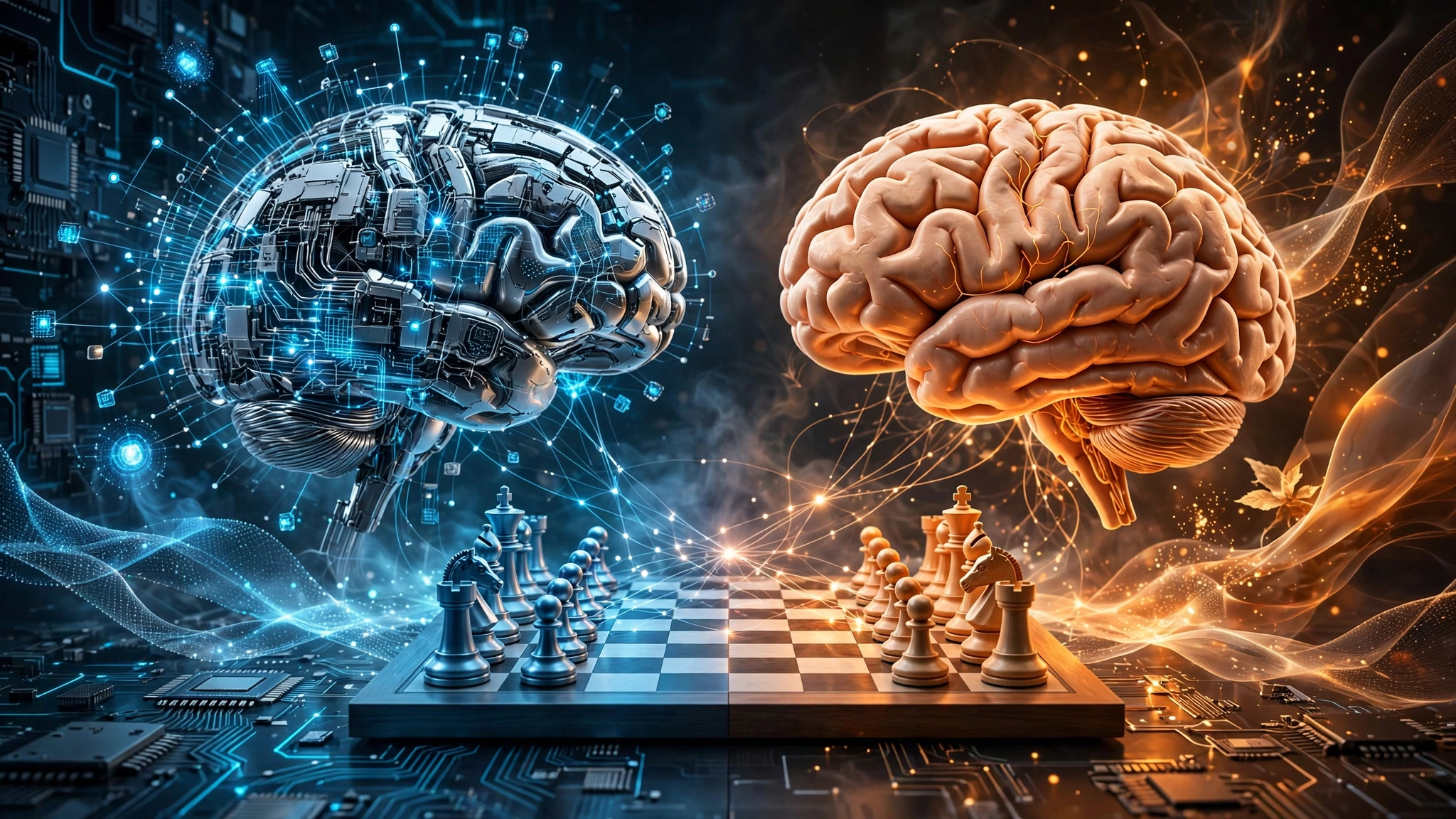
The boundary between synthetic output and biological cognition has undergone its most profound shift yet. Moving past the initial novelty of chat interfaces, generative models have integrated deeply into the fabric of enterprise infrastructure, software development, and creative workflows.
What was once framed as a zero-sum replacement dynamic—machines vs. humans—has evolved into a complex operational dynamic defined by agentic systems, multimodal interfaces, and specialized human reasoning. Understanding the division between artificial processing and human insight is no longer an abstract theoretical exercise; it is an urgent requirement for strategic survival.
The Core Dynamic: Speed vs. Synthesis
To navigate the current landscape, organizations and creators must first distinguish between the core operational mechanics of algorithmic models and biological brains.
       GENERATIVE AI                            HUMAN INTELLIGENCE
┌───────────────────────────┐                ┌───────────────────────────┐
│ • Scale & Speed           │                │ • Contextual Intuition    │
│ • Pattern Extraction      │   COLLABORATIVE │ • Emotional Empathy       │
│ • Multi-Task Execution    │ ══════════════>│ • Lived Experience        │
│ • Zero Cognitive Fatigue  │   FRAMEWORK    │ • Ethical Judgment        │
└───────────────────────────┘                └───────────────────────────┘
The fundamental contrast rests on how each intelligence type processes reality. Generative AI operates at unmatched scale. Trained on vast visual, auditory, and text corpuses, advanced models synthesize millions of data variables in fractions of a second. They do not suffer from physical fatigue, contextual memory drift over long documents, or standard human cognitive biases during repetitive task execution.
Conversely, human intelligence relies on lived experience, contextual nuance, and emotional resonance. Where machine learning identifies statistical relationships within existing datasets, human minds form leaps of intuition born from non-linear observations, physical senses, and cultural empathy.
Key Differences: Generative AI vs. Human Intelligence
| Dimension | Generative AI Capabilities | Human Intelligence Strengths |
| Creation Basis | Pattern recognition and statistical recombination | Lived experience, emotion, and sensory perception |
| Operational Scale | Analyzes millions of data points instantly | Limited volume processing; deep narrative focus |
| Task Execution | Autonomous, multi-step agentic workflows | Strategic oversight, goal definition, and governance |
| Adaptability | Data-driven re-training and real-time context windows | Experiential learning, moral judgment, and cultural shifts |
| Error Profiles | Hallucinations, edge-case failures, bias propagation | Cognitive fatigue, memory decay, personal bias |
What Changed: Shifts Reshaping the Landscape
The evolution of generative tools has fundamentally altered how humans work with technology. Key developments include:
From Chat Interfaces to Autonomous Agentic Workflows
The dominant paradigm of prompt-and-response interfaces has shifted toward fully Agentic AI. Rather than simply drafting text or generating isolated images, modern AI systems operate as continuous background participants. These models take multi-step high-level goals—such as auditing code repositories, executing API workflows, or conducting multi-source research—and break them down into self-directed sub-tasks without requiring micro-prompts at every step.
Default Multimodality as the Standard
Single-mode models (text-only or vision-only) are largely obsolete. Enterprise-grade intelligence processes audio, video, complex document layouts, and structured data streams simultaneously. This allows systems to cross-reference visual blueprints against legal specifications while listening to live meeting audio, bringing machine perception much closer to human sensory processing.
The Operational Shift to Inference Economics
As models became embedded directly into business applications, the core operational hurdle moved from training cost to inference optimization. Organizations are deploying specialized, smaller domain-specific models (SLMs) alongside dynamic routing architectures to balance compute costs against real-time decision quality.
Where Human Intelligence Remains Irreplaceable
Despite rapid performance leaps in automated systems, human judgment remains indispensable across critical operational domains.
Emotional Depth, Empathy, and True Originality
Generative AI excels at recombining existing ideas, but it cannot experience life. It has no personal stakes, grief, joy, or cultural heritage. High-value creative writing, brand storytelling, and strategic communications rely on biological empathy to forge genuine connections with human audiences. AI can surface creative variations, but human intuition selects the singular idea that resonates.
Moral Responsibility, Ethics, and Governance
Algorithms lack moral agency. They execute optimization criteria based on historical patterns, which frequently encode legacy biases. Decisions involving medical triage, legal accountability, high-stakes hiring, or ethical governance require human accountability. A machine can analyze options, but humans must bear the weight of consequences.
Contextual Edge-Case Navigation
When faced with unprecedented scenarios—market shifts without historical precedent, novel technical failures, or complex social negotiations—generative models often fail or output confident errors. Human professionals draw upon abstract reasoning to improvise solutions when historical training data offers no precedent.
The Emerging Paradigm: Augmented Human Intelligence
The forward-looking strategy is not competition; it is systematic integration. Leaders and creators are restructuring roles around a central formula: AI for production velocity, Humans for direction, curation, and original thought.
[ Raw Data & Ideas ] ──> [ AI Multimodal Processing ] ──> [ Human Editing & Governance ] ──> [ High-Value Output ]
To thrive in this environment, technical and creative professionals should focus on building specific hybrid capabilities:
- Strategic Orchestration: Transitioning from executing routine tasks to managing networks of agentic tools, setting boundaries, and auditing execution quality.
- Deep Domain Expertise: Cultivating specialized knowledge to spot subtle machine hallucinations and validate complex outputs.
- High-Touch Interpersonal Skills: Prioritizing negotiation, ethical decision-making, team empathy, and complex relationship building that machines cannot replicate.
- Prompt and System Architecture: Designing tight context boundaries, knowledge graphs, and approved data pipelines for automated tools to draw from.
The competitive advantage no longer belongs to those who possess basic procedural technical skills, nor to those who reject artificial intelligence entirely. Success belongs to professionals who use machine scale to eliminate routine cognitive friction, reserving their mental energy for deep, original, and deeply human work.