Arabic baby names are known for clear meanings and a pleasing sound. Families across the Arabic-speaking world use them, along with many Muslim families in South Asia, Africa, Europe, and North America. Arab Christians and Jews also use many of the same names, and some names appear in several faith traditions.
This guide lists classic and modern Arabic names with meanings, explains why spelling varies, and offers pronunciation notes for English speakers. It also shows how to blend an Arabic name with a name from another culture, and how to check a name before you commit.
Why spelling varies
Arabic uses its own script, with 28 letters, and it runs from right to left. English spellings of Arabic names are transliterations. That means each spelling is someone's best attempt to write Arabic sounds with Latin letters.
Two features cause most of the variety. First, everyday Arabic text usually leaves out the short vowels, so the reader fills them in. A transliterator has to guess which English vowel to use. Second, Arabic has sounds that English lacks, such as the guttural "kh" and "gh" and a deep "q". Different writers handle those in different ways.
The result is a long list of valid spellings. Muhammad appears as Mohammed, Mohamed, and Muhammed. Omar appears as Umar. Yusuf appears as Yousef and Yousuf. Pick one form early and use it on every record.
Names for girls
The table lists girls' names with meanings and common variants.
| Name | Meaning | Common variants |
|---|---|---|
| Aisha | alive, living | Ayesha, Aysha |
| Amira | princess | Ameera |
| Layla | night | Leila, Laila |
| Zainab | fragrant tree, father's jewel | Zaynab, Zeinab |
| Maryam | form of Mary | Mariam, Meriem |
| Zara | blooming flower, radiance | Zahra, Zaara |
| Rania | gazing, queenly | Ranya |
| Hana | happiness | Hanaa |
| Dalia | branch or vine | Dahlia |
| Noor | light | Nour |
Some of these names also appear outside Arabic. Hana means flower in Japanese. Dalia is a Hebrew name as well, and it shares a spelling with the dahlia flower. Check which meaning you want your child to carry.
Names for boys
The table lists boys' names with meanings and common variants.
| Name | Meaning | Common variants |
|---|---|---|
| Ali | exalted, noble | Aly |
| Omar | flourishing, long-lived | Umar |
| Hamza | strong, steadfast | Hamzah |
| Yusuf | form of Joseph | Yousef, Yousuf |
| Hassan | good, handsome | Hasan |
| Zayn | grace, beauty | Zain, Zane |
| Rayan | gates of paradise, lush | Rayyan, Ryan |
| Sami | elevated, lofty | Samy |
| Idris | studious, an early prophet | Edris |
Zayn and Zain are good examples of how a variant can move between cultures. Zane is a separate English name, but it sounds close to Zayn, so the two sometimes get mixed up.
Pronunciation notes for English speakers
A short pronunciation guide helps teachers, doctors, and new friends say the name right the first time. These are approximate, and regional accents vary.
Aisha is often said "EYE-sha". Layla is "LAY-la". Zainab is "ZY-nab". Omar is "OH-mar". Hamza is "HAM-za". Yusuf is "YOO-suf". Amira is "ah-MEE-ra".
If a name has a sound English does not use, tell people which approximation you prefer. A child with an Arabic name will usually hear several versions from strangers. A clear, calm correction early on makes life easier.
Meanings and religious background
Arabic names are used by people of many faiths, but many are tied to Islamic history and tradition. Yusuf is the Arabic form of Joseph, and Maryam is the Arabic form of Mary. Both appear in the Quran. Idris is named as an early prophet.
If a name has religious importance in your family, learn its background. Ask an elder or a trusted teacher. A short conversation can add meaning that a table cannot.
Also note that some names have several meanings. Layla means night, and in poetry it is linked to dark beauty. Check which sense fits your family's view.
Compound names and family naming customs
Arabic naming has customs that many families still follow. Learning them can help you pick a name that fits.
One common pattern is the compound name that begins with "Abd", meaning servant of. Abdullah means servant of God. Abdulrahman means servant of the Merciful. These names pair "Abd" with one of the names for God.
Another custom is the kunya, a family nickname that begins with "Abu" for father of or "Umm" for mother of. A man named for his eldest son Ahmad might be called Abu Ahmad. The custom shows how family links appear in everyday names.
You do not need to follow these customs. But knowing them helps you see why families care about names and how they treat a child's name over a lifetime.
How to choose an Arabic name
Use this order to narrow your list.
- Read the meaning. Choose one you would be glad to explain.
- Check how it reads in English. Names such as Ali and Noor travel well. Names with sounds like "kh" or "gh" may need a pronunciation note.
- Test it in every language your family uses. The name should work in each.
- Choose a spelling. Match the one on your passport or other key records.
- Ask for family input. Many Arabic names carry family meaning.
- Say it with your last name. Check the rhythm and the sound at the join.
Blending with your own names
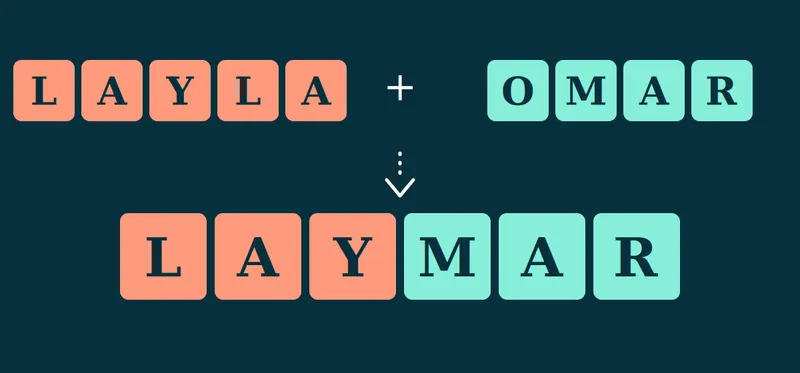
If you want something personal, blend your names. Take Layla and Omar. Our tool returns 28 blends. Laymar scores 92, Laylomar scores 92, Layloma and Omala score 88, and Laylar and Laylom score 86.
Laymar keeps the "lay" from Layla and the "mar" from Omar. It is short and easy to say. For a real name with a known meaning, try the baby name generator and look at the Arabic-origin names that share letters with yours. The baby name combiner is the right tool if you want blends alone.
Pairing with names from other cultures
Many families blend two cultures. An Arabic first name can pair with a middle name from another tradition, or the other way around. Yusuf Daniel and Layla Grace are both easy to say.
Check the sound at the join. Names that end in a vowel followed by a name that starts with a vowel create a pause. Names that end in a consonant followed by a name that starts with the same consonant blur together. Say the full name aloud to catch both.
Also consider how each side of the family will say it. If both pronunciations feel natural, the name will serve the child in both worlds.
Handling spelling on documents
Records need one spelling. Passports, birth certificates, school files, and medical records should all match. A mismatch can cause delays that show up years later, such as when a visa or a bank account needs identity checks.
If your child will have an Arabic passport, ask which Latin spelling it uses. Many Arabic passports include a Latin transliteration, and your child's English documents should match it. Write the chosen spelling down and keep it with other important papers.
Some places limit which characters a name can contain. A few U.S. states, including California, limit birth certificates to the 26 letters of the English alphabet, so accents and special marks may not appear. Check with your local vital records office.
Mistakes to avoid
- Choosing a spelling that confuses people. Pick the form most readers can say.
- Skipping the meaning check. Similar-sounding names can have very different meanings.
- Ignoring religious background. Some names are tied to figures in faith traditions. Learn the story first.
- Mixing spellings across records. Pick one and use it everywhere.
- Forgetting nickname possibilities. Short forms such as Ali for Alina or Sami for Samira can change the feel.
Classic names and rarer picks
Some Arabic names are widely used around the world. Ali, Omar, Aisha, and Layla fall into that group. People in many countries know them, and they are easy to spell and say in English.
Other names are less common outside Arabic-speaking communities. Idris, Rania, and Rayan have a fresher feel in many English-speaking places. They still carry strong meanings, and they offer a way to stand out without being hard to say.
If you want a classic, choose from the first group. If you want something less common, look at the second. A short list that mixes both helps you see how each feels with your last name.
Names that work in both Arabic and English
Families who live between two languages often want a name that sounds natural in both. A few names do this well.
Ali is short and easy in both languages. Sami and Omar have clear, simple sounds. Noor, Zara, Layla, and Hana are soft and open, so English speakers rarely stumble on them. Each of these has an easy spelling in Latin letters and a clear meaning in Arabic.
Names with sounds such as "kh" or "gh" are beautiful, but English speakers may say them in a different way. That is not a reason to avoid them. It simply means you will explain the sound more often.
Writing the name in Arabic
Many parents also want the name in Arabic script, for family records or for a keepsake. Ask a fluent speaker to write the name for you, and check that the spelling matches the pronunciation you want.
Arabic script has fixed letter forms, so the written name is stable even when the Latin spelling varies. Keep a copy of the Arabic form with your child's papers. It gives you a reference if someone later asks which Latin spelling is the correct one.
Sibling sets
When you plan more than one child, think about how the names sound together. Arabic names offer a wide range of endings and syllable counts, so you can build a set with some variety.
A set such as Layla and Omar works because the names are distinct. They start with different sounds and have different lengths. A set such as Amira, Aisha, and Alia may be harder to keep apart when called across a room, since all three start with a vowel and end in "a".
Check the initials as well. Siblings with matching initials can cause mix-ups on mail and forms.
Balancing meaning and feeling
A meaning matters, but so does the feeling a name gives you. Some parents choose a name for its meaning and later find the sound does not suit them. Others fall for a sound and learn the meaning afterward.
Try this. Say the name aloud ten times over a week. Then read the meaning. If both feel good, you have a strong choice. If one feels flat, think about whether it matters. Neither one has to be perfect, but both should be at least comfortable.
Teaching a child to say their own name
Children with names from a different language often learn to introduce themselves in two ways. They use the family pronunciation at home and a simpler one with strangers. That is normal, and many people do it all their life.
Help your child feel at ease with both. Say the name correctly and with pride, and explain the meaning when they ask. Tell them they can correct people or not, depending on the moment. A child who knows the story of their name usually carries it with confidence.
Frequently asked questions
Do Arabic names work outside Arabic-speaking countries?
Yes. Many, such as Ali, Zara, Layla, and Noor, are easy to say in English and many other languages.
What if the spelling varies?
Pick one form and use it consistently. Official documents should match each other.
Can I combine an Arabic name with a name from another culture?
Yes. Pick a combination that is easy to say in both languages, and say the full name aloud before you decide.
Are Arabic names only for Muslim families?
No. Many are used by Arab Christians and other communities, and some names appear in several faith traditions.
How do I confirm a meaning?
Ask a family elder, a teacher, or a trusted reference. Meanings can vary by region and tradition.
Can I blend an Arabic name with my own name?
Yes. A blend works best when it is easy to say in both languages. Use the tool to see options and then test them with family.
Conclusion
Arabic names offer depth of meaning and a wide range of sounds. Choose the one that fits your family's language and values, check the spelling, and say it aloud with your last name. For a calm way to make the final decision, read how to choose a baby name. For more ideas drawn from meaning, see strong baby names.