Baby names from the parents' names can take five main forms. You can blend the names, match a shared sound, use a parent's name as a middle name, build the link through initials, or match the meaning. Each approach honors both parents in a different way. You can use one, or combine several.
Many parents want a name that carries something from each of them. That wish is common and old. This guide shows how to turn it into a real shortlist, with examples you can test in the baby name generator.
Why parents use their own names
A name is a gift that lasts a lifetime, so parents often want to attach something personal to it. Using a parent's name, or a piece of it, gives a child a quiet link to family. It also tells a small story that parents can share later.
Traditions around this vary around the world. Many Spanish-speaking countries give children two surnames, one from each parent. Iceland uses patronymic names, where a child's last name comes from a parent's first name, with endings meaning "son of" or "daughter of". In many families, a grandparent's name passes down as a first or middle name. The five ways below borrow from those habits.
From two names to a short list
- Enter two namesUse first names. Add a gender and style if the tool offers them.
- BlendThe tool tries many cut points and joins the pieces.
- RankEach blend gets a flow score. Hard-to-say blends sink.
- Save and testSave favorites, then say each one with your last name.
Way 1. Blend your names
The most direct approach is to join part of one parent's name with part of the other's. You can do it by hand or with our baby name combiner.
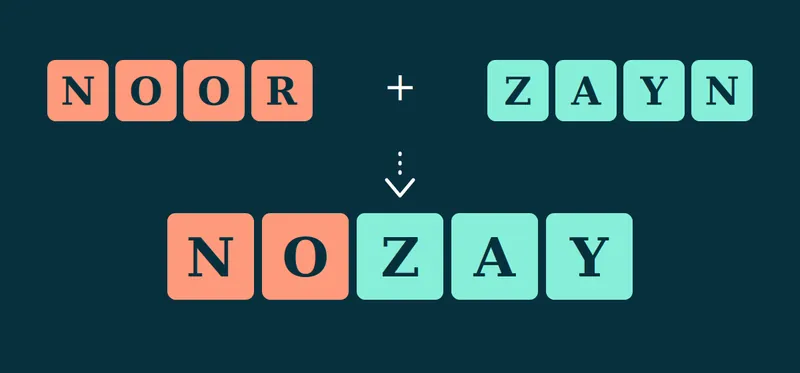
Take Noor and Zayn as an example. The tool returns 27 blends. Several tie at 88, including Nooza, Nozay, Zanoo, and Zayno. Of these, Nozay is the easiest to say. It keeps the "no" from Noor and the "zay" from Zayn.
A blend works best as a first name when it is smooth and easy to spell. When it is more unusual, it works better as a middle name. You get the link to both parents without asking a child to explain an invented name every day.
Way 2. Match a shared sound
Sometimes two names share a sound that is not obvious from the spelling. Noor has a long "oo" sound. Zayn has a long "ay" sound. A real name that echoes one of those, or both, can feel connected without copying any letters.
You can search for this by sound. List the strongest vowel in each name. Then look for names that use the same vowels in a new arrangement. Our baby name generator ranks real names by shared first letters, shared endings, and shared letters overall. Names that match more of these rank higher.
This approach suits parents who want a standard name with a hidden link. Nobody else will notice the connection, but you will.
Way 3. Use a parent's name as the middle name
This is the simplest way and one of the oldest. Pick a first name you love, and then add one parent's name in the middle.
A middle name rarely appears in daily use. It shows up on documents and during formal moments. That makes it a good home for a family name that might not fit as a first name. A baby named Luna Sara carries Sara without being called Sara every day.
Many families also use a mother's maiden name as a middle name. This keeps a family surname alive when the baby takes a different last name. Check how it sounds with the full name, because some surnames make awkward middle names.
Way 4. Build the link through initials
If you do not want to change the name itself, build the link through the letters. A baby whose first and middle names start with the parents' initials carries a subtle signal.
With Noor and Zayn, a baby might have a first name starting with N and a middle name starting with Z. The initials N and Z could then appear in a monogram. Always write the full set of initials before you decide, including the last name. Some combinations spell words you would not want on a backpack.
This approach pairs well with the others. You might use a blend as a middle name and pick a first name that shares the initial of one parent.
Way 5. Match the meaning
Meaning gives you another route. Look up what each of your names means, and then find a name that expresses a related idea.
Noor means "light" in Arabic. Zayn is often given with the sense of "grace" or "beauty". A name linked to light, such as Aurora, which means dawn, or Clara, which means clear and bright, echoes Noor without copying it. A name built on grace echoes Zayn. The nature-inspired baby names guide lists many names grouped by meaning.
Meanings are not exact. They shift by language and tradition. Treat the meaning as a theme, not a translation, and confirm it with family if it matters to you.
Comparing the five ways
The table shows how the methods differ in effort and feel.
| Way | Effort | The result feels | Best if you want |
|---|---|---|---|
| Blend | Low with a tool | New and unique | A name nobody else has |
| Shared sound | Medium | Subtle | A gentle link |
| Middle name | Very low | Traditional | To honor a family name |
| Initials | Low | Private | A hidden link |
| Meaning | Medium | Thoughtful | A story to tell |
Mixing the methods
You do not have to pick only one. A baby could have a real first name chosen for its meaning, and a blend of the parents' names in the middle. The first name handles daily life, and the middle name holds the family link.
Another mix pairs a middle name with the initials. One parent's name becomes the middle name, and the first name starts with the other parent's initial. That way, each parent appears once, in a different place.
If you are choosing between two strong options, use one as a first name and the other as a middle name. That settles the debate without a loser.
Testing your shortlist
Once you have a shortlist, test it. Say each full name aloud with the last name. Write the initials. Ask a friend to spell the name after hearing it once. Look up the meaning in each language your family speaks.
Then give yourself time. Sleep on the list for a few days. A name that still feels good after that has a real chance of lasting. The pronounceability checklist covers the sound checks in more detail.
Mistakes to avoid
- Forcing a blend. If it feels clumsy now, it will feel clumsy later.
- Ignoring other cultures. Check that the pieces do not form an unintended word in a language that matters to your family.
- Choosing before testing. Say the full name aloud a few times first.
- Putting both parents in one spot. Spreading the link across first and middle names often works better.
- Taking every opinion. Family input is useful, but the choice belongs to the parents.
Naming traditions you can borrow from
Cultures around the world already link children to their parents through names. You can borrow the idea without copying the whole system.
In Spanish-speaking countries, a child usually carries two surnames, one from each parent. You can echo this by giving a child two middle names, one from each side, or by pairing a parent's name with a first name.
In Iceland, a child's last name comes from a parent's first name, plus an ending that means "son of" or "daughter of". You might borrow the idea by choosing a first name that honors a parent's given name in sound or meaning.
In Arabic naming, the word "ibn" means "son of" and "bint" means "daughter of". Traditional names can list several generations. Many modern families keep the spirit of this by using a parent's or grandparent's name in a child's name.
Honoring a grandparent
A grandparent's name can be a strong way to link generations. Many families use it as a middle name. Others use it as a first name, especially when the name is still in fashion.
If the grandparent's name feels dated, try a related form. A name such as Eleanor can become Elena or Nora. A name such as William can become Liam. These forms keep the link but sound current. Ask the grandparent first. Many are touched, and some have strong views on spelling.
Parents from different cultures
When parents come from different backgrounds, a name can bridge both. Look for names that work well in each language. A name such as Maya, Sara, or Noor appears in several languages and cultures, and each carries a slightly different meaning.
Check pronunciation in every language involved. A name that sounds easy in one language can feel foreign in another. Also check the spelling. A child with a name that both sides of the family can say and write has a small advantage in daily life.
Writing down the story
Whatever approach you choose, write down why you chose it. A short note, a page in a journal, or a message saved to your phone is enough. Include the date, the names you considered, and what the final name means to you.
Children often ask about their names. A real answer, in your own words, is a gift that lasts longer than any blend. It also helps relatives who ask later why you made the choice you did.
Questions to ask before you pick a way
A few honest questions can point you to the right approach. Do you want the name to look obviously linked to both parents, or do you prefer a quiet link? Does a family name carry weight that deserves a first-name spot? Will your child be fine with an unusual spelling? Do you want a story to tell, or a name that is simply easy?
If you want a visible link, blend. If you want a quiet one, use sound, initials, or meaning. If you want to honor a person, use the middle name. If you want an easy life for the child, choose a familiar first name and keep the personal part in the middle.
A one-week plan
A short, steady plan beats a rushed night of debate.
- Day one. Each parent lists ten to fifteen ideas alone.
- Day two. Run both names through the baby name combiner and save five blends.
- Day three. Check meanings and origins for the real names on your list.
- Day four. Say every finalist with the last name and write the initials.
- Day five. Cut the list to three.
- Day six. Share the three with one trusted person each.
- Day seven. Decide, or take one more day.
This pace keeps the process calm. It also gives you time to notice when a name grows on you or wears thin.
When relatives disagree
Family opinions can be loud. A name that you love may get a cold reaction. Try not to take it as a verdict.
Ask what bothers them. Sometimes the objection is about a nickname, a pronunciation, or a memory tied to the name. Those are real, and you may learn something. Other times it is just surprise, which fades. Decide whether the concern changes your view. If it does not, thank them and move on.
Frequently asked questions
Should a blended name be the first or the middle name?
Either works. If the blend is unusual, many parents use it as a middle name and keep the first name familiar.
Can I mix names from different cultures?
Yes. Check pronunciation in each language so the name feels natural to both sides of the family.
What if both parents have very short names?
Use a full name plus a piece, or use the parents' names as middle names instead.
How many ideas should I collect?
Gather ten to fifteen, then narrow to three. Fewer than that can feel rushed, and more can feel overwhelming.
Do the methods work for same-sex parents?
Yes. None of the methods depend on the parents' gender.
Is it fine to honor only one parent?
Yes. Some families do this when one name has special meaning. Others balance it by using the other parent's name for a second child.
Conclusion
You do not need a perfect formula. Try the five ways, save what you like, and revisit the list in a few days. When you are ready to decide, read how to choose a baby name.