To combine two names, cut each name at a natural break and join the pieces into one new word. That is all a name blend is. The tricky part is choosing a result that sounds smooth. A good blend is easy to say, easy to spell, and still shows both of the original names.
This guide covers six ways to do it by hand. You will also see how our name combiner ranks results, so you can judge a blend the same way. Along the way, I will point out the mistakes that make a blend feel clumsy.
Where name blends come from
Linguists call a blended word a portmanteau. Lewis Carroll popularized the term in *Through the Looking-Glass* in 1871. In the book, Humpty Dumpty explains that "slithy" packs two meanings into one word. English has taken that habit and run with it ever since.
Plenty of everyday words started as blends. "Brunch" appeared in 1895, from breakfast and lunch. "Smog" followed in 1905, from smoke and fog. "Motel" arrived in 1925, from motor and hotel. None of these needed a rulebook. People just joined sounds that fit.
Names work the same way. Couples, friends, and parents have blended names for a long time. Today the practice is easy to spot on wedding signs, shared accounts, and pet name tags. The rules are loose, but a few patterns show up again and again.
Prepare your names first
Spend two minutes on prep before you start cutting. It saves a lot of wasted tries.
Write each name in lowercase. Use the spelling you want on the final result, not the one on a birth certificate. If a name has two parts, such as Mary Ann, pick the part you actually use. If you go by a nickname, test both forms.
Next, say each name out loud and count the syllables. Ali has two. Sara has two. Jordan has two. Elizabeth has four. Short names leave little room to cut, so they often work best with a method that keeps one name whole.
Then listen for the sound, not the spelling. Sara and Zara rhyme in most accents even though they start with different letters. Names that share an ending sound, such as Elena and Lena, blend almost on their own. Names that share nothing, such as Mark and Brook, need more work.
Method 1. The classic blend
Take the start of the first name and the end of the second. Then reverse the order and try again.
The best cut points fall where a vowel meets a consonant. In Ali, that point sits between the "a" and the "l". In Sara, it sits after the first "s". Cutting there keeps syllables intact, so the result reads as a word.
For Ali and Sara, the classic blend gives Alara. That comes from "Al" plus "ara". Our tool scores it 88 out of 99. Reverse the order and you get Sali, from "Sa" plus "li". It is shorter and sounds a bit more like a nickname.
Test both directions. One often sounds clearly better than the other.
Method 2. A full name plus a piece
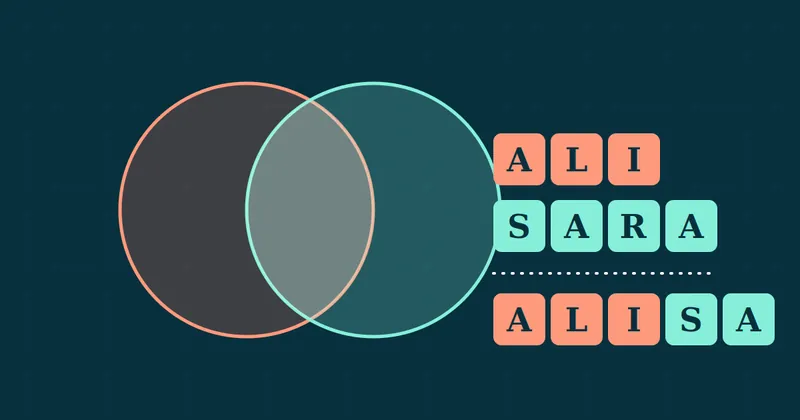
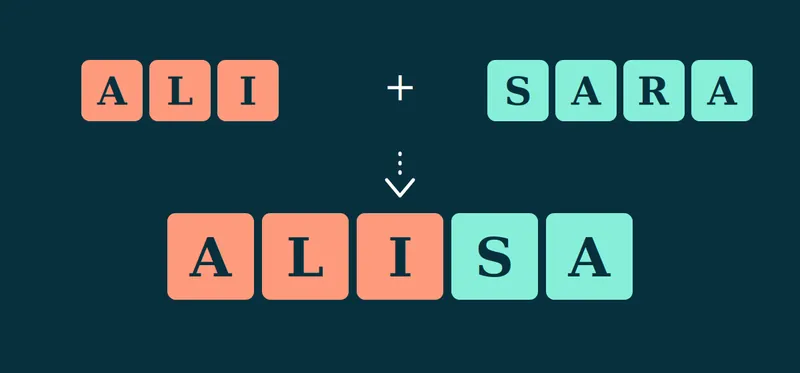
Here, one name stays whole and the other gives only a part. For Ali and Sara, keeping Ali and adding "sa" gives Alisa. Keeping Sara and adding "li" gives Sarali.
This method has one big advantage. People can still see the original name. Alisa starts with Ali, so it feels like a gift to the person named Ali. That matters when the blend is for a wedding sign or an anniversary gift.
The weak spot is balance. If one name is much longer, the result can feel lopsided. Christopher plus Ann would produce something that is mostly Christopher. In that case, shorten the long name first, then blend.
Method 3. The short mashup
A short mashup takes the first part of each name. Emma and Liam can become Emli. Ali and Sara can become Alsa.
These blends are compact. They suit usernames, pet names, and nicknames. They also look good on small items such as a keychain or a mug.
The risk is that short mashups can look chopped. Many end on a hard consonant, which makes them sound abrupt. If the blend feels cut off, add one more letter from the second name or try a classic blend instead.
Method 4. The shared-letter overlap
Some names already share letters at the join. Look at where one name ends and the other begins. If the last letters of the first name match the first letters of the second, you can fuse them.
Jordan ends in "an". Anna begins with "an". Joined at that spot, they become Jordanna. Our tool found 47 blends for this pair, and Jordanna scored highest at 96.
Overlaps feel natural because the seam is already there. Your ear does not notice a join. The catch is that most pairs do not overlap at all. Ali and Sara have no matching letters at the join, so this method gives nothing for them. Do not force it.
Method 5. Pair formats
Sometimes you do not need one new word. Two names joined by an ampersand or a hyphen can read better than a blend.
"Ali & Sara" works on invitations, signs, and captions. "Ali-Sara" looks like a double name and suits a shared account. A monogram such as "A + S" fits a logo or an engraving. These formats keep both names intact, so nobody feels left out.
Use a pair format when the names are very short, very long, or hard to blend. Mark and Brook, for example, produce blends like "Broma" and "Mabro" that sound a little odd. "Mark & Brook" is simpler and reads fine.
Method 6. Sound-first blending
This method ignores spelling and works from the sounds. Say both names slowly. Find the stressed syllable in each. Then build a new name around those two sounds.
Layla and Aiden both carry a long "ay" sound. A blend built on that sound might be Layden, which our tool scores 92. A looser version, such as "Aylen", keeps the sound but changes more letters.
Sound-first blends take more time. They also tend to produce the most natural results, because they follow how people actually speak. If you have ten minutes, try this method before you pick a final name.
Four ways to blend two names
How to read the results
Once you have candidates, you need a way to compare them. Our name combiner gives each blend a flow score from 5 to 99. For Ali and Sara, the tool returns 16 blends. The top few are Sarali (94), Alisar (92), Saral (92), Alara (88), Alira (88), and Alisa (88).
The score rewards a short list of traits. It likes five to eight letters, a mix of vowels and consonants, two or three syllables, and an ending on a vowel. It also checks that both names appear in the result. It subtracts points for three consonants in a row and for awkward joins.
Treat the score as a filter, not a verdict. A score above 80 means the blend is easy to say. It does not mean the blend is right for you. Two names with the same score can feel very different, and only you can say which one fits.
How the flow score works
Every blend starts at 40 points, then gains or loses points for how easy it is to say. The final score is kept between 5 and 99.
Adds points
- +14Both names show up (40%+ of letters from each)
- +10Length of 5 to 8 letters
- +10Vowels make up 33-55% of letters
- +8Two or three syllables
- +8Names overlap on 2+ letters
- +6Ends in a vowel (a, e, i, o, y)
- +6Vowel and consonant meet at the join
Takes points away
- -20Same letter three times in a row
- -12Three consonants in a row
- -10Four or more vowels in a row
- -8Over 10 letters, or too few or too many vowels
- -6Two consonants collide at the join
A simple way to test your favorites
Once you have a shortlist, run these steps in order.
- Say each blend out loud three times.
- Write it down and ask someone to read it back without help.
- Spell it aloud to another person and see if they write it correctly.
- Say it next to a last name, a pet name, or a place name, depending on how you will use it.
- Wait a day and look at the list again.
The third step catches the most problems. If a friend writes "Alisa" as "Aleesa" or "Alissa", you have found a spelling issue before it appears on a sign or a document.
Common mistakes
Most bad blends fail in one of a few ways.
- Cutting too much from one name. If one name supplies a single letter, it is not really in the blend.
- Stacking consonants. Three in a row, as in "Chranna", slows the tongue and looks heavy on the page.
- Skipping the reverse order. The same two cut points can sound very different when flipped.
- Ignoring meaning. A blend can accidentally match a word in another language. Check the languages your family speaks.
- Choosing the first good one. Compare at least five before you decide.
Where blended names work best
Couples use blends for wedding hashtags, joint accounts, and house signs. A blend works well there because both people want to feel included. Read our guide on couple name ideas for more on that.
Parents sometimes use a blend as a baby name or a middle name. That use needs extra care, since the child will carry it for life. The baby name combiner guide explains how to handle it.
Writers use blends for characters who share a bond. Friends use them for group chats. Gamers use them for handles. In each case, the same advice holds. Keep it easy to say and easy to spell.
Handling tricky name pairs
Some pairs fight back. A little planning helps you get through them.
Two names that start with the same letter, such as Mark and Maya, share a built-in head start. Use that letter once and move on. Marya keeps the shared "Ma" and then splits into "rk" and "ya". You do not need to repeat the opening sound.
Two names that end the same way, such as Elena and Lena, can fold into each other. In that case, the longer name often already contains the shorter one. A blend adds nothing, so a pair format may work better.
A very long name, such as Alexandria, needs trimming before you blend it. Cut it to "Alex" or "Alexa" first. Then blend. If you skip this step, the result tends to run past ten letters, and our tool drops it from the list.
Names with silent letters create a hidden trap. Say the name aloud and write what you hear. Knight sounds like "night". A blend that follows the spelling instead of the sound will confuse readers.
Blending names from other languages
Many names use letters or accents that do not appear in basic English spelling. Our tool folds those accents away, so Zoë is treated as Zoe. That keeps the blend readable on forms and signs.
If a name comes from a language with a different alphabet, such as Arabic, Hindi, or Korean, start with the spelling you use in English. Then check how the blend sounds in the original language. A blend that sounds smooth in English may sound strange to a grandparent who speaks the other language.
The reverse also happens. A blend can accidentally land on a real word in another language. A quick search on the blend, plus a short chat with relatives, usually catches it.
Matching the method to the purpose
Think about where the blend will live before you pick a favorite. The same pair can need different answers in different places.
A wedding hashtag needs to be short and easy to type. A short mashup or a classic blend works best. A joint business name needs to look professional, so a full-name blend or a pair format is safer. A pet name needs to be easy to shout, so choose two syllables and a clear vowel sound.
A character name in a story has different needs. Readers should be able to hear it in their heads, so avoid spellings that offer two possible sounds. A baby name needs the most care of all. It will outlast any wedding sign, so it should pass every test in the checklist below.
Frequently asked questions
How many letters should a combined name have?
Five to eight letters is the easiest range for most people. Names under four letters can feel like nicknames. Names over ten tend to get shortened.
Can I combine more than two names?
Yes. Blend the first two, then blend that result with the third. Three-name blends get long quickly, so trim each piece first.
Does the new name have to be a real word?
No. Many familiar names began as invented blends. The only test is whether people can say and spell it.
What if my names are very short?
Use a full name plus a piece, or choose a pair format such as "Ali & Sara".
Is a blend the same as a ship name?
In everyday use, yes. A ship name is a blend of two people's names, often used for couples or fictional pairs.
Do I need to understand syllables to do this?
Not really. Cutting where a vowel meets a consonant works most of the time, and the tool does that for you.
Try it with your own names
Type your two names into the name combiner. You will see every blend ranked, with color coding that shows which letters came from which name. If the blend is for a baby, the baby name combiner adds labels for how each name leans, and our guide to baby names from parents' names shows how to choose between them.