Pronounceability measures how easily people can say a name on the first try. A blended name can look perfect on screen and still trip the tongue in real life. A short checklist catches most of those problems before you commit.
This guide explains seven checks. Each one has a clear reason behind it and a clear fix. The same rules sit behind the flow score in our name combiner, so you will see how the tool thinks as well.
Why sound matters more than spelling
A name is spoken far more often than it is written. Teachers call it in class. Doctors call it in waiting rooms. Friends shout it across a street. If the sound is awkward, people will avoid it or shorten it.
English has roughly 40 to 44 distinct sounds, depending on the accent. A name uses only a handful of them. That small set can still be arranged in ways that feel easy or hard. Easy names alternate between consonant and vowel sounds. Hard names bunch similar sounds together.
The checklist below turns that idea into rules you can apply in a minute. It is not a perfect model of speech. It is a practical filter that works for most English speakers.
How the flow score works
Every blend starts at 40 points, then gains or loses points for how easy it is to say. The final score is kept between 5 and 99.
Adds points
- +14Both names show up (40%+ of letters from each)
- +10Length of 5 to 8 letters
- +10Vowels make up 33-55% of letters
- +8Two or three syllables
- +8Names overlap on 2+ letters
- +6Ends in a vowel (a, e, i, o, y)
- +6Vowel and consonant meet at the join
Takes points away
- -20Same letter three times in a row
- -12Three consonants in a row
- -10Four or more vowels in a row
- -8Over 10 letters, or too few or too many vowels
- -6Two consonants collide at the join
Check 1. The vowel and consonant balance
A smooth name mixes vowels and consonants. In our scoring, a name earns 10 points when vowels make up between a third and a half of its letters. It loses 8 points when vowels fall below a quarter or rise above 65 percent.
Aurora is vowel-heavy, with four vowels in six letters, so our rules trim a few points from it. It still reads well because consonants separate the vowels. A name with almost no vowels, such as "Brgth", fails because there is nothing to carry the sound.
To check by hand, count the vowels, including "y" when it sounds like one. Divide by the total letters. If the result falls between 0.33 and 0.55, you are in the sweet spot.
Check 2. No long consonant runs
Three consonants in a row slow the tongue. Four in a row can stop it. Our tool subtracts 12 points for a run of three and another 10 for a run of four.
English does allow some clusters, especially at the start of a word, as in "Stra" or "Chri". The trouble comes when a blend creates a cluster that no real name has. The pair Chris and Anna illustrates this. Among its 25 blends, Annachri scores 82 and Chrianna scores 76. Both are held back by the "chr" group, even though they are otherwise balanced.
If your blend has a long cluster, move the cut point. Trade one consonant for a vowel from the other name, or drop a letter.
Check 3. No stacked vowels
Vowels pile up less often than consonants, but they cause problems too. Two vowels together, as in Liam or Noor, are fine. Three in a row are rare in English names, and four are very hard to read. The tool takes 8 points for three vowels in a row and 10 more for four.
Stacked vowels also raise a spelling question. "Aoi" could be read three ways. When people cannot tell how to say a name from its letters, they guess, and they often guess differently.
To fix it, break the pile with a consonant. Replace one vowel or move the cut point so a consonant lands in the middle.
Check 4. A comfortable length
Length matters for both speech and writing. Our tool gives 10 points for names of five to eight letters, 4 points for names of four or nine, and subtracts 8 points for anything over ten.
Short names feel quick. Longer ones feel formal. Past ten letters, many people shorten the name without asking. Layladen is 8 letters and works. Aidelayl at 8 letters scores 82 but looks tangled. Count the letters, and then read the name aloud to see if it still feels natural.
If you plan to use the name on forms or in small spaces, shorter is better. Many online forms limit names to a set number of characters.
Check 5. A gentle ending
The last sound sets the tone of a name. Endings in a vowel, or in a soft consonant such as n, l, r, s, and m, feel open. Hard endings such as k, t, and x feel sharp.
In the scoring, a vowel ending earns 6 points, and an ending in n, l, r, s, or m earns 4. A hard ending earns nothing. That does not make hard endings bad. Names such as Mark and Brook work well. It simply means a blend needs more help from other traits to score high.
When a blend ends too sharply, try swapping in the ending of the other name or adding a vowel.
Check 6. One obvious spelling
A name that people spell several ways will cause friction. This check is about the match between sound and letters.
Say the name to a friend and ask them to write it down. Layden might come back as Layden, Laiden, or Leyden. All three are plausible, and each one signals a different pronunciation. If you want the name to stay Layden, you will be correcting people for a long time.
Choose spellings that follow common English patterns. "ay" is more predictable than "ey" or "ai" at the start of a name. Avoid silent letters and doubled letters that do not change the sound.
Records add another reason to care. Government forms, school files, and medical systems all need one spelling. A name with three common variants will appear in three forms across your records.
Check 7. The last-name test
A first name always sits next to a surname. A blend that sounds great alone can fall apart next to a particular last name.
Watch for three things. First, the end of the first name and the start of the last name should not blur. "Ellen Nelson" runs together because the "n" sounds repeat. Second, the stress pattern should feel balanced. A long first name before a long surname can feel heavy. Third, the combination should not form an unwanted word or phrase.
Say the full name five times quickly. If you stumble, the pairing needs work. If it flows, you have passed.
Fixing a name that fails
Most problems have simple fixes. The table shows common ones.
| Problem | Example | Fix |
|---|---|---|
| Three consonants in a row | Chranna | Cut a letter to get Chana |
| Hard to spell | Layden or Laiden | Pick one spelling and stick to it |
| Too long | Aidelayl | Choose a shorter blend such as Layden |
| Blurs with last name | Ellen Nelson | Change the ending or pick another name |
| Stacked vowels | Aoia | Place a consonant between the vowels |
A worked example
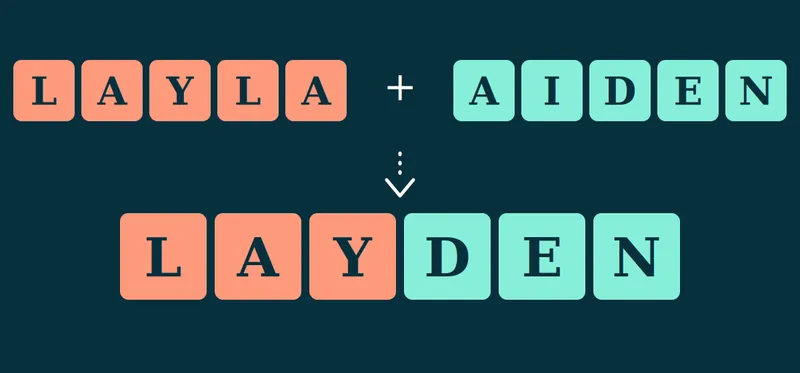
Take Layla and Aiden. Our tool returns 36 blends. The top results are Layden (92), Laylen (86), Layladen (86), and Laylaide (84).
Run Layden through the checklist. Vowels (a, y, and e) make up half of its six letters, which sits inside the good range. There are no consonant runs. There are no stacked vowels. It has six letters. It ends in "n", a gentle consonant. The spelling is the one weak point, since "Layden" and "Laiden" both seem plausible. The last-name test depends on the surname.
That gives Layden five clear passes, one watch point, and one open item. Most parents would be comfortable with that result.
What the checklist cannot tell you
A checklist measures sound. It cannot measure meaning, culture, or taste. A blend can pass every check and still mean something unwelcome in another language. It can also be a famous brand or the name of a character you would rather avoid.
For those problems, you need people. Ask relatives who speak other languages. Search the name online. Then give yourself time. If a name still feels right after a week, it probably is.
Stress and rhythm
Syllable count shapes the rhythm of a name. In our scoring, names with two or three syllables earn 8 points. A name with a single syllable loses 4 points. That does not mean short names are bad. It means a one-syllable blend often feels like a fragment, not a complete name.
Stress matters too. Most English first names put the stress on the first syllable, as in LAY-den or EM-ma. A blend that shifts the stress to a later syllable can feel foreign to English ears. That is fine if you want it, but you should know it is happening.
To test, tap out the beats as you say the name. Two or three even beats usually feel comfortable. Five or six beats start to feel like a phrase.
Reading a name on a screen
People meet names on screens as often as in speech, so check how the letters look.
Some letters are easy to confuse. A lowercase "l" and a capital "I" look alike in many fonts. The pair "rn" can look like an "m" at small sizes. Doubled letters such as "ll" and "nn" can read as a single letter when the text is small. If your blend includes any of these combinations, view it at small size before you decide.
Capital letters matter too. A name that looks good in lowercase may look odd with a capital first letter. Type it out in the places where it will appear and see.
Accents and regional differences
Pronunciation changes from region to region. In many American accents, "Mary", "merry", and "marry" sound the same. In other accents, they are three different words. A blend built around one of those sounds can be clear in one region and confusing in another.
If your family or community spans several accents, ask a few people to say the name. Listen to how each one does it. Differences are not a reason to drop the name. They are a reason to know what to expect.
Testing with real listeners
A quick test with three people tells you more than an hour alone. Here is a simple way to run it.
Pick three people who have not seen the name. Say it aloud once and ask each to repeat it back. Then ask each to write it down. Note any spelling variations. Finally, ask each what they think the name means or sounds like. Their answers will reveal hidden associations.
If all three repeat the name correctly and spell it the same way, it is a clear name. If two or three differ, decide whether the difference matters to you.
Names that break the rules and still work
Rules are guides. Plenty of lovely names fail one or two checks. Zayn ends in "yn" and has only one syllable, yet it reads cleanly and has a clear sound. Mark ends in a hard "k". Brook uses a double "o". Both are common and easy.
The lesson is simple. A score tells you where a name is likely to cause trouble, but it does not forbid anything. If a blend fails one check and you love it, look at why. Often the fix is small. Sometimes you decide the trade-off is fine.
Frequently asked questions
Does a high score mean the name is good?
It means the name is easy to say. Whether it fits you is a separate question that only you can answer.
Are rare names a problem?
No. Rare names can be lovely. Just make sure the spelling and sound are clear enough to avoid daily corrections.
Should I test with different accents?
Yes, if your family speaks more than one language or comes from different regions. A name that sounds smooth in one accent may sound harder in another.
How many people should I ask?
Three or four is enough. Pick people who have not seen the name before, so you get fresh reactions.
Do hard consonants make a name worse?
No. They give a name a firmer feel. The checklist only warns against long clusters of them.
Can I apply this checklist to non-English names?
Partly. The balance, length, and spelling checks apply to any name. The specific sound rules fit English best.
Conclusion
Run each finalist through the seven checks and fix the weak spots. Then read how to choose a baby name if the blend is for a child. You can test any pair in the name combiner and see the scores for yourself.