Four methods cover almost every name blend. They are the classic blend, the full name plus a piece, the short mashup, and the shared-letter overlap. Each one suits a different kind of name pair. The method that gives a smooth result for Ali and Sara can fail for Christopher and Anna.
This article compares the four head to head. You will see how each method treats the same pair of names, where each one breaks down, and how to choose before you waste time on the wrong one. If you want the basics first, read how to combine two names.
How we compare the methods
A fair comparison needs clear criteria. We use five.
- Readability. Can a stranger read the result aloud on the first try?
- Balance. Does each name supply a fair share of the letters?
- Recognition. Can you still spot both original names?
- Length. Does the result stay between five and eight letters?
- Flexibility. Does the method work for many kinds of pairs, or only a few?
No method wins on all five. A short mashup is very flexible but can look chopped. A full-name blend scores high on recognition but can run long. The right choice depends on what you value most.
One pair, four methods
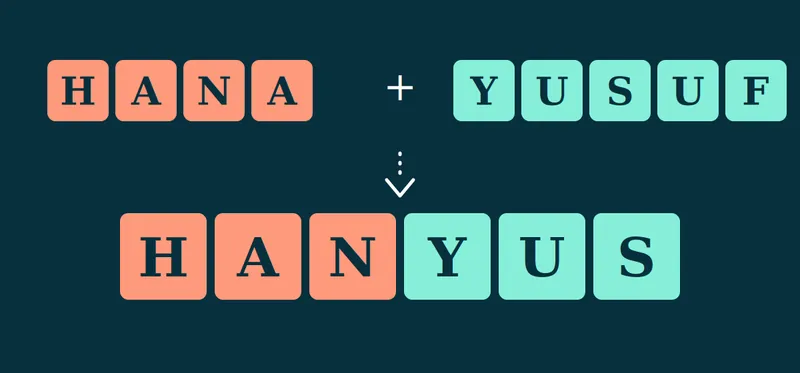
A single example makes the differences easy to see. We ran Hana and Yusuf through the name combiner, and it returned 39 blends. Here is how the four methods treat them.
Four ways to blend two names
The classic blend takes the start of one name and the end of the other. For this pair, it produces Yusana (score 94), built from "Yus" and "ana". The result is smooth and clearly shows both names.
The short mashup joins the first part of each name. It gives Hanyus (92) and Yuhan (92). Both are compact. Hanyus reads like a nickname, while Yuhan sounds almost like a real name.
The full-name blend keeps one name whole. It gives Yuhana (88), where "Hana" stays intact behind "Yu". It also gives Yusuha (88), though that one leans heavily on Yusuf.
The overlap method finds nothing for this pair. Hana ends in "ana" and Yusuf begins with "yu", so no letters line up. That is normal. Overlap only works when the endings and beginnings happen to match.
The classic blend in detail
Classic blends are the workhorse. They cut each name at a vowel-to-consonant boundary and swap the halves. Because the cuts follow syllable edges, the results usually look like real words.
The method works best with names of medium length, roughly four to six letters. Those names have two or three cut points each, which gives you a good number of combinations. It also works when the names have different vowel sounds, since the seam becomes a natural place for the sound to shift.
It struggles with very short names. A three-letter name has only one or two usable cut points, so you end up with the same few results. It also struggles when both names end in the same consonant, because the seam can pile up hard sounds.
The full-name blend in detail
A full-name blend keeps one name whole and adds a piece of the other. It is the best method for recognition. Anyone who knows the whole name will spot it immediately.
This method fits a pair where one name is short and one is long. The short name stays whole, and the long name supplies only a small piece. That keeps the total length under control. It also fits cases where one person cares a lot about keeping their name intact.
The main weakness is balance. If the whole name is long, it takes over. For example, a blend that keeps all of "Alexandria" and adds two letters from "Sam" will feel like Alexandria with a small tail. Cut the long name first, then blend.
The short mashup in detail
A short mashup joins the starts of both names. It makes compact results, and those results suit nicknames, usernames, and small items such as keychains.
Short mashups are also the most flexible method. Almost any pair of names produces a few usable results. That is why they often appear at the top of the list for awkward pairs. For Mark and Brook, for instance, the best results are all short mashups. Broma scores 94 and Mabro scores 94.
The cost is polish. Many short mashups end on a consonant sound that feels cut off. If the result seems abrupt, try adding one more letter from the second name. Alternatively, switch to a classic blend.
The overlap in detail
The overlap fuses two names at a spot where letters already match. When it works, it is the smoothest method of all, because the join is already built into the names.
In our tests, Jordan and Anna were the clearest case. Jordan ends in "an" and Anna begins with "an", so they fuse into Jordanna, which scores 96. That was the highest score in any pair we ran.
The limit is frequency. Most pairs have no overlap at all. Do not twist the spelling to create one. If the match is not there, move on to another method.
Which method for which pair
Use the table below as a starting point. It matches the shape of your names to the method that usually works best.
| Your pair | Try first | Why |
|---|---|---|
| Two short names (3 to 4 letters) | Pair format or full-name blend | Little room to cut |
| One short, one long | Full-name blend with the short name kept whole | Keeps the total length down |
| Two long names | Classic blend with trimmed halves | Avoids results over ten letters |
| Same first letter | Short mashup | Share the opening once |
| Same ending sound | Overlap | The seam already exists |
| Very different sounds | Classic blend, then test the seam | Needs a smooth shift |
Treat the table as a guide, not a rule. If the first method gives poor results, try the next one. The tool shows all of them together, so you do not have to choose in advance.
What affects the number of results
The number of blends depends mostly on name length. Longer names have more cut points, so they produce more combinations. Ali and Sara, two short names, returned 16 blends. Maya and Omar returned 19. Mark and Brook returned 26. Hana and Yusuf returned 39. Jordan and Anna, with two longer names and an overlap, returned 47.
A short list is not a problem. It simply means the pair has fewer clean options. Pay more attention to the top three results and ignore the rest.
Scoring across methods
The flow score does not favor any single method. It looks at the final name, not at how it was made. As a result, scores overlap across all four methods. A short mashup can outscore a classic blend, as Hanyus (92) beats Yuhana (88) here. A classic blend can outscore a full-name blend, and the reverse can happen too.
This is useful because it keeps the comparison honest. You do not need to trust a method. You can read the name and judge it yourself.
Combining two methods
You do not have to stop at one method. Many good results come from a two-step approach.
Start with an overlap or classic blend to get a base. Then trim or extend it using a second idea. For example, take "Yusana" and shorten it to "Yusa" for a nickname. Or take "Jordanna" and drop one letter to get "Jordana". Small edits like these can turn a good blend into a great one.
Another approach is to blend with a nickname. If Yusuf goes by "Yus", then blending "Yus" with "Hana" gives different results than the full name. Try both forms.
A scorecard for your favorites
Once you have three or four finalists, score each one from zero to five. Give one point for each yes.
- Easy to say on the first try.
- Easy to spell after hearing it once.
- Both original names are clear.
- Five to eight letters long.
- Sounds good with the last name or the place you will use it.
A blend with four or five points is a strong pick. A blend with two or fewer should go back to the drawing board. The pronounceability checklist goes deeper on the first two questions.
Common mistakes when comparing methods
- Trying only one method. The best result often comes from a method you did not expect.
- Ignoring the reverse order. Each method gives different results when you flip the names.
- Trusting the score too much. Two blends with the same score can feel very different.
- Skipping the length check. A great sound at eleven letters is still hard to use.
- Forcing an overlap. If the letters do not match, accept that and move on.
A longer look at Ali and Sara
Ali and Sara make a good test case because both names are short. The tool returns 16 blends. The top six are Sarali (94), Alisar (92), Saral (92), Alara (88), Alira (88), and Alisa (88).
Sarali and Alisar both keep one name whole and add a piece of the other. Saral is a short mashup, and it drops the "i" from Ali to stay compact. Alara and Alira are classic blends with different cut points. Alisa keeps Ali whole and adds "sa" from Sara.
Notice how little separates these results. Five of the six score within six points of each other. At that point the score stops being useful, and your own taste takes over. Pick the one that sounds most like a name you would call out loud.
How the tool filters weak results
Our tool does not show every possible blend. It removes results that fail a few simple tests, so you spend your time on options worth reading.
A blend must be between four and twelve letters long. Each original name must contribute at least two letters. The result cannot match either original name. It also cannot be a plain join of the two full names, since that is concatenation and not a blend. Finally, duplicates are merged, and the tool keeps the version with the higher score.
These filters explain why some pairs produce fewer results. Very short names fail the two-letter rule more often. Pairs with repeated letters produce more duplicates.
Choosing a method by use
The best method also depends on where the name will live.
A baby name needs the most careful choice. Pick a classic or full-name blend that scores above 80, then check meaning and spelling. A couple name can be more playful, so short mashups and overlaps are fine. A username should be short and easy to type, which favors short mashups. A character name in fiction should be easy for a reader to say in their head, so lean on classic blends with clear spellings.
If you are unsure, start with the classic blend. It gives the widest range of readable results, and you can switch methods later.
Frequently asked questions
Which method is most popular?
Classic blends and full-name blends are the most common, because both are easy to read.
Do I need to know about syllables?
Not much. Cutting where a vowel meets a consonant works most of the time, and the tool handles it for you.
Why do some pairs give fewer results?
Short names have fewer cut points. Names with repeated letters can also produce duplicates, which the tool removes.
Does the method change the score?
No. The score looks at the final name only, so any method can produce a high score.
Can I use a nickname instead of the full name?
Yes. Nicknames often give better blends, because they are shorter and closer to how people actually say the name.
What if no method works?
Use a pair format such as "Hana & Yusuf". It needs no cutting and still shows both names.
Conclusion
Choose the method by the shape of your names, then test the results with your own ears. The name combiner runs all four methods at once, so you can compare them side by side. If you are building a name for a baby, read how to choose a baby name before you commit.