A couple name is a nickname built from both partners' names. You make it by taking pieces from each name and joining them into one word. People use these names on wedding signs, shared accounts, gifts, and pet name tags. Done well, the result sounds warm. Done badly, it sounds like a typo.
This guide walks through the full process. You will learn how to cut the names, how to compare options, and where a couple name fits best. You will also learn when to skip the blend and use a simpler format.
Why couples make a shared name
A shared name solves a small but real problem. Two people often need one label. A wedding needs a hashtag. A new joint account needs a handle. A dog needs a name that reflects both owners.
A blend also feels personal. A hyphenated pair says two people. A blend says one unit. Many couples like that idea, especially around a wedding or an anniversary.
The practice has a long tradition in language. Blended words such as "brunch" and "smog" show that people enjoy joining sounds. A couple name uses the same instinct, only with two first names as the raw material.
Start with the sounds, not the spelling
Say both names out loud before you write anything. Pay attention to the vowel sounds, because they carry the flow of a name.
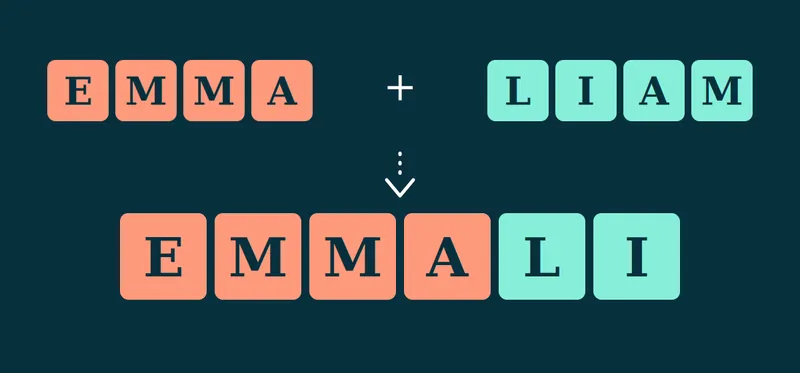
Emma has a short "e" and ends in a soft "ah". Liam has a long "ee" and ends in a nasal "m". Those two sounds sit well together. A blend that moves from one to the other, such as Emmali, feels smooth.
Now try a pair that does not match as well. Mark and Brook both lean on hard consonants. Blends from that pair, such as "Broma" and "Mabro", work but sound a bit forced. When names clash like this, you need to pay more attention to the seam, which is the spot where the two pieces meet.
The simple recipe
You can do this by hand in five steps, or use our name combiner to skip the manual work.
- Write both first names in lowercase.
- Mark each name where a vowel meets a consonant. Emma splits as "em | ma". Liam splits as "li | am".
- Join the start of one with the end of the other. "Em" plus "am" gives Emam. "Li" plus "ma" gives Lima.
- Try the full-name-plus-piece style. "Emma" plus "li" gives Emmali.
- Compare your options and keep the one a stranger could read on the first try.
For Emma and Liam, the tool returns 27 blends. The top results include Liamma (94), Limma (94), Emmiam (92), Emmam (92), and Emmali (88). Notice that high scores do not always mean good taste. "Emmiam" scores well but looks cluttered. You still have to use your eye.
Examples across different styles
The style you choose changes how the blend feels. Each one suits a different mood.
| Names | Blend | Style | Notes |
|---|---|---|---|
| Emma + Liam | Emmali | Full name + part | Keeps Emma whole |
| Jordan + Anna | Jordanna | Shared-letter overlap | Joined at "an" |
| Ali + Sara | Alara | Classic blend | Smooth and balanced |
| Hana + Yusuf | Yuhana | Full name + part | Keeps Hana whole |
| Zara + Idris | Zaris | Classic blend | Short and crisp |
Every blend in that table scores 88 or higher in our tool. Even so, a high score does not replace your own judgment. Read each one aloud before you commit.
Where a couple name works
The best use depends on how public the name will be.
On a wedding sign or hashtag, keep the blend short. Guests type hashtags on small screens, and a long blend invites typos. Five to seven letters is a good target.
For a shared account, check availability first. Many handles are already taken. A blend with an unusual spelling is more likely to be free, though it is also harder to remember.
On a gift, such as an engraved board or a framed print, a pair format often looks better. "Emma & Liam" has a clean, formal feel. A monogram such as "E + L" looks good on a small item where space is tight.
For a pet, a blend can be playful. Many couples name a first pet after both of them. Go with something short and easy to call across a yard.
Check the blend before you use it
A few quick checks can save you from embarrassment.
Search the blend online. Some blends match a brand name, a slang word, or a place. A search takes ten seconds and can prevent a poor surprise.
Say it in front of a friend and watch their face. A smile is a good sign. A pause or a frown means you should try another.
Test the reverse order too. "Lima" and "Emam" feel very different from each other. If one sounds better, use it.
Finally, ask your partner. A couple name only works if both people like it. If one of you winces, drop it and keep looking.
When a blend does not work
Some name pairs just resist blending. Two names that both end in a hard consonant, such as Mark and Brook, can produce a clumsy join. Names with very different lengths, such as Al and Alexandria, leave one side with almost nothing.
In those cases, use a pair format. "Mark & Brook" is clean and clear. You can also build something playful from initials, such as "M+B". Neither format needs a clever cut, and both read well on a sign.
Another option is a themed nickname that has nothing to do with the letters. Some couples pick a shared word, such as the street where they met. That is not a blend, but it fills the same need.
Common mistakes
- Letting one name dominate. If the blend is 80 percent one name, the other person will notice.
- Choosing a hard-to-spell blend. You will spell it aloud for years.
- Skipping the reverse order. The flipped version may be clearly better.
- Forgetting nicknames. If you use a short form of your name, test the blend with that too.
- Overusing it. A couple name is a small flourish. It does not need to appear everywhere.
A worked example from start to finish
Here is how one pair might move through the process. Take Jordan and Anna.
Step one is the sounds. Jordan has two syllables with a strong first beat. Anna has two soft syllables. Both end in "an" or "na", so there is a hidden link at the seam.
Step two is the cut. Jordan splits as "jord | an". Anna splits as "an | na". Because Jordan ends in "an" and Anna begins with "an", the two names can overlap. Fusing them at that spot gives Jordanna.
Step three is the comparison. Our tool returns 47 blends for this pair, more than for any other pair we tested. Jordanna scores 96. Jonna scores 94 and Joranna scores 94. Jordanna keeps both names fully visible, so it wins on balance.
Step four is the real-world test. Say it out loud. Say it with a last name. Ask a friend to spell it. Jordanna passes all three, because the spelling matches the sound. At that point, the couple has a name they can put on a sign.
Making a handle that is available
A shared account needs more than a nice sound. It needs a name that nobody else owns. Common blends are often taken, so plan for that.
Start with the blend you like most. If it is taken, add a short, neutral element such as a number, a city initial, or a year. Avoid long strings of digits, because they look careless and are hard to remember. Keep the handle under about fifteen characters so it fits on a profile page without cutting off.
Try the reverse order too. "Annajor" and "Jordanna" are different strings, and one may be free when the other is not. Also try the pair formats. A handle that reads as "emmaandliam" is long, but it is clear and rarely taken.
Write the handle in lowercase when you check it. Most platforms ignore case, and you want to see how it will look in a web address.
Using a couple name at a wedding
Weddings give a couple name its biggest stage. A blend can appear on invitations, signs, cups, and a hashtag. Each of those has different needs.
On paper, a pair format reads best. "Emma & Liam" looks formal and clear. Save the blend for informal items such as a welcome sign or a napkin.
For a hashtag, shorter is better. Guests will type it on their phones during the day, and each extra letter increases the chance of a typo. Keep it to six or seven letters if you can. Test it by asking two people to type it after hearing it once.
For a cake topper or a sign, think about the look of the letters. Names with tall letters, such as "l" and "d", look good in script. Names heavy on round letters look good in print. A designer can tell you more, but a quick sketch on paper helps you decide.
When partners disagree
It is common for one partner to love a blend while the other does not. Do not push it. A couple name should make both people smile.
Try a trade. One person picks the method and the other picks the final blend. Or each person chooses a favorite, and you test both on friends. If neither works, set the blend aside for a week. Many couples find that a name they disliked grows on them, and a name they loved starts to bother them.
If you still cannot agree, a pair format is a safe middle ground. It avoids picking one name over the other, and it needs no cutting at all.
A couple name is separate from a surname
A couple name does not replace a legal name. It is a casual label, and it has no effect on records, documents, or surnames. Some couples enjoy the idea because it feels like a middle path. They keep their own names and still share a word.
That separation also frees you to be playful. You can change the blend later, use different versions in different places, or retire it. No office needs to approve it. Treat it as a small tradition that grows with you.
Couple names for other kinds of pairs
The method works for any two people. Friends, siblings, coworkers, and teammates all use blends. A parent and child sometimes make one for a shared hobby or a family business. A pair of founders may blend their names into a company name.
The same checks apply in each case. The blend should be easy to say, easy to spell, and fair to both names. The only real difference is the audience. A group chat can be silly. A company name needs more care, since customers will see it and search for it.
Keeping a couple name fresh
A name that feels clever on day one can feel stale after a few years. Plan for that. Use the blend in a few places and leave the rest alone.
Many couples find that a name grows warmer over time if they use it in private moments. A text, a note, or a toast at an anniversary dinner keeps it personal. Overusing it in public tends to make it feel like a brand. That may be what you want, but it should be a choice.
Frequently asked questions
Do couple names need both full names?
No. Most use only parts of each name. The goal is that both people can hear themselves in the result.
Is a couple name the same as a ship name?
In everyday use, yes. A ship name usually refers to a blended name for a fictional or celebrity pair, but the method is the same.
Can I use a couple name for a baby?
You can use it as a starting point. Our guide to the baby name combiner covers names built for a child.
What if the blend sounds like another word?
Check the meaning in any language your family or friends speak. If it is a problem, try the reverse order or another method.
How many options should I compare?
Look at five to ten. Fewer than that can feel rushed, and more can make the choice harder.
Can friends or siblings use the same method?
Yes. The steps do not depend on the relationship. Friends often use blends for group chats and teams.
Final thoughts
A couple name is a small thing, so keep it light. Try a few blends in the name combiner, say them out loud, and keep the one that makes you both smile. If you want to learn how the different styles work, read how to combine two names next.